
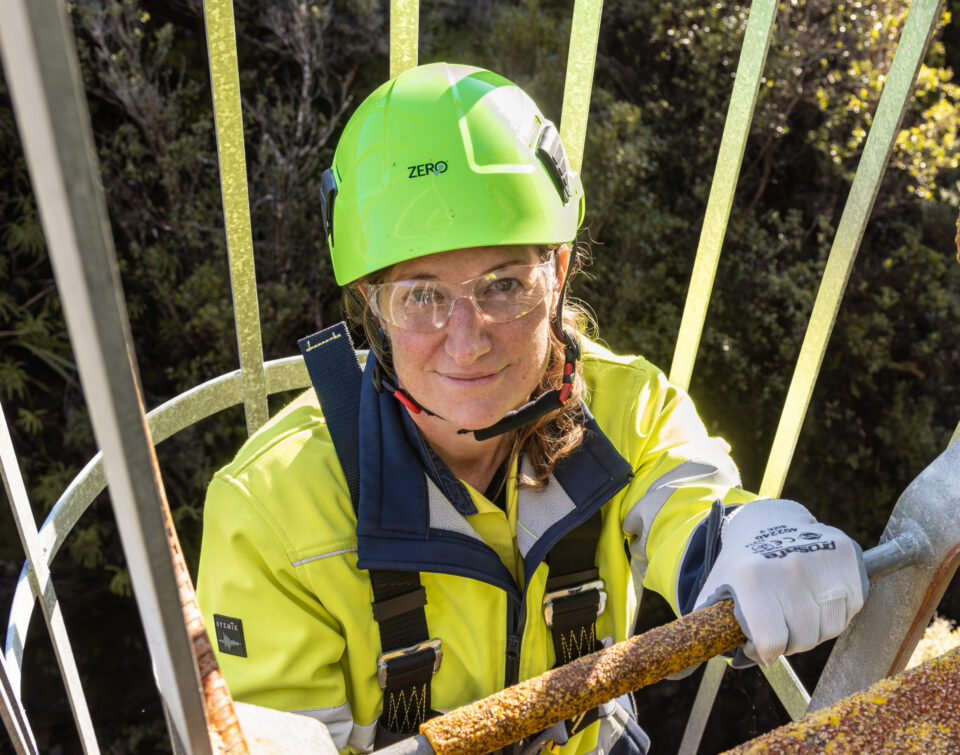

Image: Jodi Murray.
Jodi Murray was awarded the Komatsu Women in Extractives ‘Leader of the Year’ 2025 – an honour that came as a bit of a surprise to her at the industry awards lunch held in Christchurch last March. Hosted by Straterra, AQA, and MinEx, and supported by IOQNZ and AusIMM, this event celebrates diversity and inclusion in the extractives industry. By Mary Searle Bell
The Leader of the Year Award, sponsored by the Workforce Development Council, recognises someone who has demonstrated vision, dedication, and determination in supporting their team’s success.
Jodi says she was just doing her job. Clearly her manager and colleagues thought she was delivering much more.
As a Senior Projects and Water Engineer at the Stockton Mine, Jodi’s role is to ensure the mine stays compliant and the pits are operational.
“I make sure the water from our operations is going to the right places and is of the right quality.”
This is no small feat given that Stockton is the country’s largest open-cast coal mine and is located in a part of the country that has an annual rainfall of over five metres.
“We have seven different work areas. Each is slightly different from the next, with varying water issues for each.
“We deal with sediment runoff as well as AMD – acid metalliferous drainage, which is the outflow of acidic water caused by the oxidisation of sulphur and pyrite from the overburden and coal. This, when mixed with water, produces sulphuric acid.
“To counter this, the water is collected and has calcium oxide added to it to raise the pH level back to where it needs to be before the water goes back into the environment.”
The process also causes the heavy metals such as aluminium and iron to drop out as well and these are collected in one of the large treatment sumps from which clean, good quality water is decanted back into the natural environment.
This is a challenging and vital role, says Jodi, and perhaps not one you’d expect for someone who didn’t know what she wanted to do when she left school and headed off into the workforce without direction.
“I enjoyed science and maths at school, but I didn’t get given career options around them. My dad said I had to get a job, so I started working in a soil lab. I am forever thankful that the directors took the chance on hiring me.”
Jodi soon started to work her way through the ranks. The business had a consulting engineering arm, and Jodi started doing some engineering work and found she really enjoyed it.
“I thought, I could make a career out of this, so I started studying for a Diploma in Civil Engineering through the Northland Polytechnic. After my first year, I made the call to do an engineering degree, so I quit my job and, at the age of 25, headed to the University of Canterbury, straight into the first professional year of a civil engineering degree.”
After graduating, Jodi started working with Golder Associates as a geotechnical engineer.
“The job had me working away a lot, throughout New Zealand and Australia. In 2008, I was sent to Stockton Mine and worked as a consultant there for about 18 months. I would spend two weeks living in Westport and then two back in Christchurch.
“Then, a management change at the mine meant no more consultants, so I joined the staff permanently as a field engineer. Four months later, when the water engineer left, I stepped into that role.
“Fifteen years later, and here we are.”
Over this time Jodi has seen a lot of change in the way things are done, both from a regulatory and environmental aspect, as well as in the general operations at the mine.
“One of the biggest changes is the sheer scale of things. We simply have a lot more disturbance and mining pits to deal with.
“The legislative and compliance side of things are always evolving, and we have more changes ahead as we work through the RMA reform.
“A lot of our consents run out in two to three years, so reconsenting will be a big task for us. We’re dealing with a very old, historic mining area; the remnant underground workings significantly influences our water quality downstream of our current work areas.”
Jodi and the team at Stockton have been proactive in their efforts to manage the water on site responsibly.
“We had a new water management structure ready to go just as the new wetland standards came out, which would have addressed the majority of the water quality issues arising from the historic underground workings. The restriction on wetland disturbance and permissions required made us relook at it and make quite a few changes.
“We scaled things back, making more use of existing structures and have plans to install a pipe to take water over the wetland rather than constructing a new treatment sump. That water management plan is currently being reviewed.”
As the mine has expanded, so has Jodi’s role and responsibilities. When she first began, she was the only water engineer on site, but in 2019 a second water engineer was hired.
“My role then moved more into project work – overseeing projects and looking at future work, rather than dealing with day-to-day operations.”
Jodi and her team work closely with a number of consultants, including Mine Waste Management. She says Paul Weber, Mine Waste’s Managing Director and Principal Environmental Geochemist, is a big advocate of women in industry and it was he who forwarded the information about the Women in Extractives awards to her manager, who then nominated her for Leader of the Year.
Bathurst Resources announced Jodi’s win on its LinkedIn page, saying Jodi’s technical skills and drive to protect the environment are backed by her leadership skills that see her sharing her extensive knowledge to lead and inspire her team.
This high praise is echoed by her colleagues at the mine, who agree that the accolade is well deserved.
“So well deserved and good to see recognition for your many years of hard work and dedication to Stockton, the environment and leading the way,” wrote one colleague in response to the post.
Jodi says she was “hugely surprised” to be named and still struggles to find words to express her feelings around the win.
“You just do your day-to-day work, you don’t think it’s award worthy. But it’s lovely to have your efforts acknowledged.
“It comes down to the people you work with, having supportive workmates and managers, that make it possible to achieve what needs to be done.”