
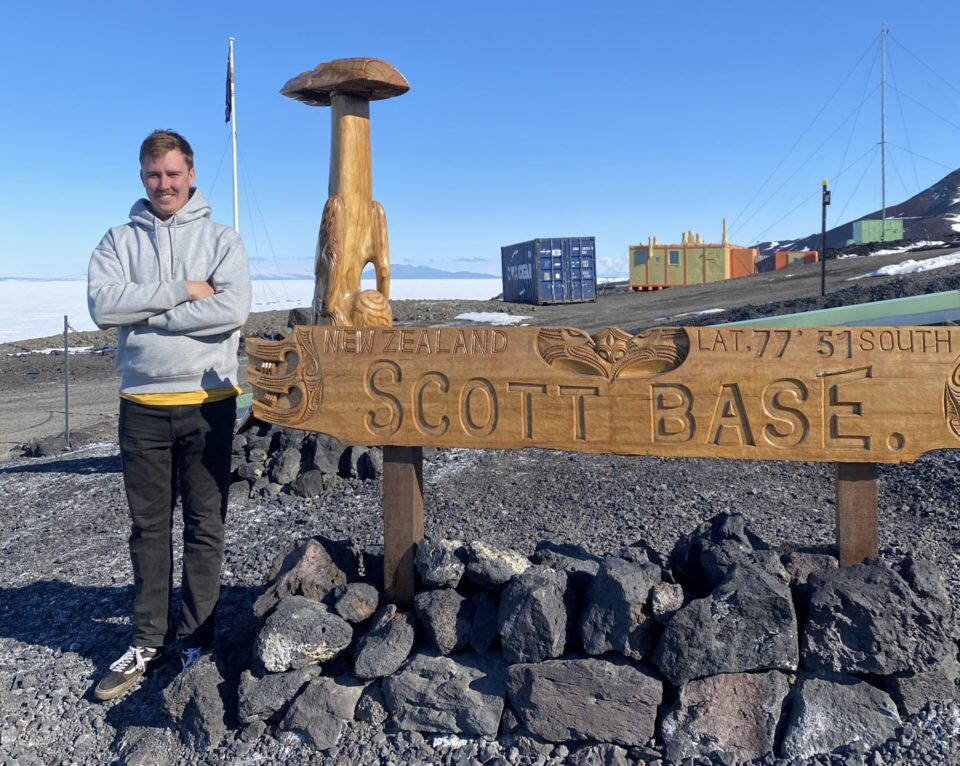

Image: Jack spent a summer in Antarctica through Fulton Hogan, operating the Grey Chutes Quarry for the United States Antarctic Programme.
Q&M magazine talks to Jack Kelliher, Quarry Manager at Fulton Hogan’s Roydon Quarry about his work, and a challenging assignment he had in Antarctica.
You grew up just outside of Christchurch, where you completed your schooling and later attended the University of Canterbury. When did you become interested in pursuing a career in the industry, and what job did you start off with?
I was always interested in mining from a young age which led me to study geology at university. It wasn’t until I made a third-year field trip to a local quarry in Canterbury that my interest in the industry was really sparked.
While studying, I worked for a local construction and piling company, Moore Construction, which was a great way to learn the ropes.
My first full-time role was with Fulton Hogan, where I got my first taste of quarrying at its Miners Road
Quarry.
What qualifications do you have/or are studying?
I hold a Bachelor of Science in Geology and a Professional Master of Engineering Geology, both from the University of Canterbury.
Since starting at Fulton Hogan, I’ve also gained my A-Grade COC and a Diploma in Mining and Quarrying Supervision. That said, the majority of my skills have been learnt on the job working alongside the people doing it every day.
Describe your current role and what it entails?
I am currently the Quarry Manager at Roydon Quarry, a large alluvial quarry owned by Fulton Hogan.
I am responsible for day-to-day operations and most importantly, the health and safety on site. Alongside managing Roydon, I am a part of the national quarry planning team, developing quarry management plans for the wider business.
What does a typical workday look like for you?
All good days start with a prestart and a review of the production plan. From there, I am out on site checking that operations are running safely and efficiently, coordinating with the team, and ensuring our production and quality targets are met.
The best part about my job is the people you meet and the places the industry can take you. Quarrying can open the doors to some incredible opportunities.
There isn’t much to dislike about my job, but there is always a breakdown you wish you never had.
One of the biggest challenges I face is balancing safety, production and environmental responsibility. The site operates under more than 250 consent conditions, so ensuring we meet those while maintaining a safe and productive site isn’t a small task.
Community expectations remain high, so we have to be very disciplined about compliance without losing sight of safety, efficiency, and the day-to-day realities of running
the site.
Describe an interesting job.
I was fortunate enough to spend a summer in Antarctica, through Fulton Hogan, operating the Grey Chutes Quarry for the United States Antarctic Programme.
This was a very unique experience working in such a remote and challenging environment, that taught me some important life skills and allowed me to meet some pretty cool people.
We went down for two trips over the 2023-24 summer (Nov–Dec and then back again in Jan–Feb).
One of the biggest challenges was adapting to the 24-hour sunlight and the lack of fresh food. People always ask about what you do with your spare time, and there was plenty to do. From riding snow mobiles, to walking to the base of Mt Erebus and everything in between.
The daily temperature never got above freezing, often being around 15-20 degrees. During blizzards, the wind chill got below minus 30 which became unsafe to work.
As you can imagine, at these sort of temperatures starting machines becomes an issue, especially cone crushers.
Daily tasks involved someone heading up before breakfast to start the heaters on the lube tank, and then usually after an hour it had reached the magic number of 20 degrees to start up. Thorough pre-starts were very important as you want to spend as little amount of time outside as possible.
The quarry was based in basaltic rock and the crushing plant consisted of a jaw, cone and screen producing a “2.5 inch minus” product to meet American specifications.
Work was six days a week to ensure productivity was at its highest and to meet deadlines. Meals were always hot and high in carbs to ensure you had enough energy to get through the cold day. Accommodation was dorm-style, sharing with a couple of others on base. A great way to meet people.
What are your career aspirations for the future?
I want to keep growing in quarry management, take on more strategic roles, and help improve how quarries operate safely and efficiently.
How involved are you with the IOQ?
I was lucky enough to be selected as the recipient for the IOQ youth programme in 2024. This was a great opportunity to build my networking skills and gain experience while establishing relationships with industry leaders.
I’m currently a member of the IOQ and attend branch meetings within the region.
Any advice for those joining our industry?
Be curious, ask plenty of questions and get stuck in. The industry will teach you skills you’ll use for life, connect you
with great people and offer experiences you’ll never forget.