
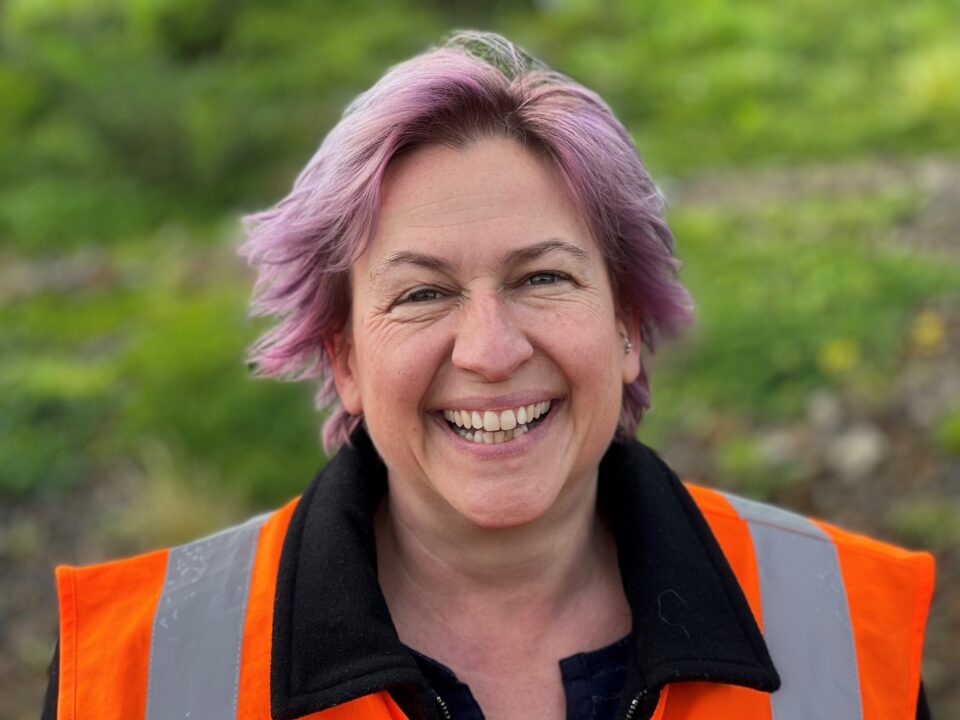
Image: Jo Prigmore began her career in the UK in a histology lab as a registered biomedical scientist with a master’s degree in asbestos-related disease.
On social media, Jo Prigmore lists her interests as “safety, wine, music and cooking”, and her skills as “experimental hair colours, foot-in-mouth statements and grammar corrections”. As Fulton Hogan’s National Manager Occupational Health and Wellbeing, Jo was the 2025 recipient of the Kristy Christensen Memorial Award as a diversity champion – for a good reason, explains Mary Searle Bell.
Kristy Christensen (1985-2022) was a Kiwi mining engineer, MinEx Board member and AusIMM NZ Branch committee member. She was named among the top 100 global inspirational women in mining by Women In Mining UK in 2020.
Kristy was an outspoken advocate for better treatment of women at mine sites, and when Jo Prigmore was named diversity champion at the 2025 Women in Extractives Awards earlier this year, it was extra sweet because she had known Kristy and had followed her lead in pushing for better conditions on work sites, such as loos.
“We used to have young girls working all day without drinking water just so they didn’t have to pee, and they end up dehydrated. It can be hot and heavy work, so drinking plenty of water throughout the day is important.
“You can’t put people in hi-viz then expect them to pee on the side of the road.
“Kristy had done a lot of work around access to toilets in mines and quarries – and it’s not a gender thing, it’s just as important for men as for women to have access to a clean toilet. Not just for going to the loo, there will be people with colostomy bags or incontinence products following things like prostate surgery.”
Jo thinks her background in health is what makes her the way she is. She says most health and safety programmes are often 80 per cent safety, with many health aspects overlooked.
A registered biomedical scientist with a master’s degree in asbestos-related disease, Jo began her career in the UK in a histology lab. However, she soon discovered she “talked too much to work in a lab” so took a job in 2000 as a health and safety inspector, tasked with assisting the government to improve industrial health and safety practices.
“The training for health and safety inspectors in the UK is awesome. It takes two years to complete, and includes things like agricultural hazards, scaffolding inspections, as well as learning to drive a tractor, and doing woodwork courses to learn about machinery.
“In my role I inspected everything from guarding machinery to traffic management to occupational health and hygiene. So, while I hadn’t worked in construction prior to joining Fulton Hogan, I had a good foundation of knowledge and came in keen to learn.”
Jo and her partner moved to New Zealand almost on a whim 23 years ago. They had visited earlier as ‘Plan B’ when a trip to the Himalayas had been thwarted by a civil uprising. Then, when planning a holiday to the USA they somehow ended up emigrating to New Zealand instead.
“I’m not sure what happened,” laughs Jo. “But we headed to the immigration fair and filled in the paperwork. We were told that our application would take six months to process, after which we would have three months to pack up and move.
“As it turned out, we got our visas the same day we applied. We had to tell our parents and sell our house almost immediately.”
Landing in Christchurch, where Jo’s partner had a job as a joiner, Jo returned to her initial career, getting a position in a lab doing cancer diagnoses. She then took a job as a case manager with ACC, later transferring within the organisation to its Blenheim office.
“When ACC closed its Blenheim branch, I saw an advertisement for a health and safety role with Fulton Hogan – that was 15 years ago.”
Jo adds that, as Blenheim is one of Fulton Hogan’s smaller sites, it was a good place to learn all parts of the business, from construction to quarrying.
Her inspection background provided a solid foundation. “The conveyors I had inspected in the UK were for food, but conveyors don’t care what they’re carrying – biscuits or boulders, they’ll still take your arm off.”
Jo says one thing she noticed back then was that the UK was ahead in many respects when it came to health and safety: “Things I thought were standard, were in fact new.
“For example, 15 years ago nip guarding wasn’t used much here – distance guarding, where an area is fenced off, was the norm. Problem is, distance guards are easily damaged or removed.
“I remember talking to Bill Perry about it, and he’d never heard of nip guarding, even though it was in the New Zealand Standard.
“I clearly remember spending a wet Easter in 2016 making a machine guarding guide out of cardboard – a rotatable disk with a cutout so you could select the size of the mesh of the guard and it would show how far away you should be from the ‘bitey bit’.
“For example, if the mesh grid is 30mm, you need to be 100mm from the bitey bit to pass the safety standard.
“We had them made up and distributed throughout Fulton Hogan. It was a practical tool the workers could have in their pockets.”
This kind of initiative showed the team that she could do more for them. “I wasn’t just there to tell them off for not wearing their glasses.”
Jo says one of her passions is trying to make things simple and easy to understand. “Our industry is full of practical people rather than academics.”
And she has practical and simple advice for other health and safety managers. “Don’t write stuff in your safety plan and then not do it. No one will read your health and safety paperwork as closely as an inspector will.
“The key is to simplify – ensure your paperwork is accurate and then do what you
write down.”
Last year, Jo’s job title was changed to National Manager – Occupational Health and Wellbeing, where she purposely focuses on the ‘health’ in health and safety, supporting the well-being of staff.
“We have adopted the ‘Mates in Construction’ programme, a charity focusing on preventing suicide in the industry.”
It is a disturbing fact that our construction industry loses nearly one person a week to suicide, with workers six times more likely to die from suicide than an accident at work.
“We set a KPI for all of our business to be accredited with Mates.”
Mates trains workers to identify and respond appropriately to signs that a co-worker may
be suicidal. It has three layers of training:
Level 1 is general awareness training, which Jo says more than 90 per cent of Fulton Hogan has accreditation in.
Level 2 is connector training. A connector can help keep someone safe in a crisis while connecting them to professional help, and Fulton Hogan has one in 20 staff with this training.
Level 3 is Applied Suicide Intervention Skills Training (ASIST) training, which equips individuals to talk to a person contemplating suicide with the object of reaching a ‘safe plan’ for the workers. Fulton Hogan has one ASIST-trained person on each of its sites.
“What it means is that if anyone is struggling with their mental health or having suicidal thoughts, there’s someone right there who can help.”
Learn more about Mates in Construction at mates.net.nz.