
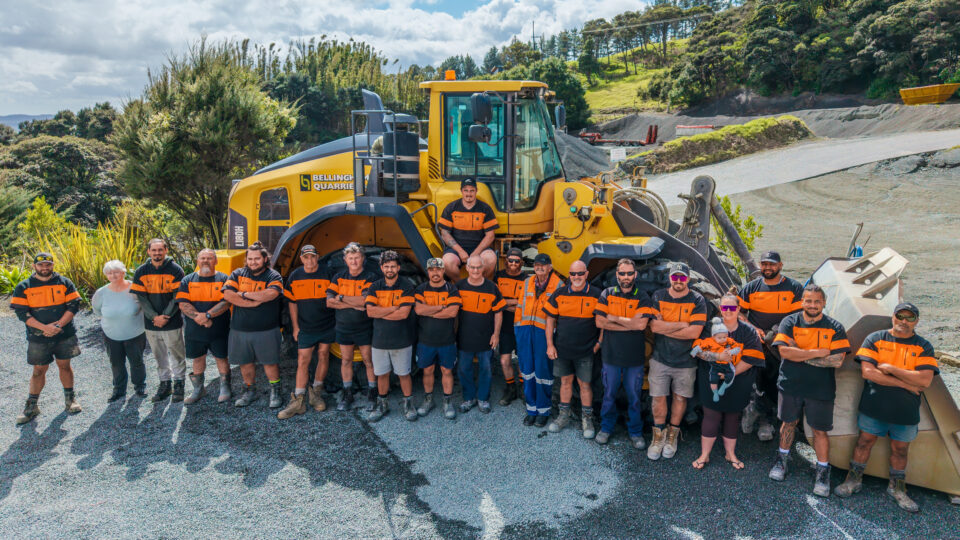

Image: The Bellingham Quarries team.
Operating for over 100 years, family-owned Bellingham Quarries have a long and interesting
history in the Far North region, writes Mary Searle Bell.
The first iteration of this family company began with Ted Bellingham and his two sons, Eric and Allan, back in the 1920s.
The enterprising men were gum diggers in the Mangawhai area, exporting the gum to Scotland where it was used to make linoleum. To improve their volume of gum, the Bellinghams purchased a Ruston rope shovel excavator, with a dragline rig.
When the Great Depression hit in the 1930s, the market for gum vanished overnight. To keep their new excavator working, the Bellinghams started doing roading work. The first contract they undertook was to widen a section of the main road south from Warkworth. While doing so, they encountered a section of rock, which had to be removed.
Back in those days, when a contractor hit rock, they were obliged to remove it without any additional compensation from the client for the cost of this work. For the Bellinghams, drilling, blasting, and excavating this section of rock meant this contract made a serious loss.
Fortunately, the then-Minister of Public Works, Bob Semple, considered this to be grossly unfair and is said to have compensated the Bellinghams out of his own pocket (or ministerial budget) for the loss, allowing the company to stay afloat and continue with roading work.
Given their experience in excavation, it was a logical step for them to move into the production of agricultural lime, and Ted set up a lime quarry and crushing plant at Matakohe.
Expansion quickly followed when, in 1937, his son Eric set up a second operation just south of Kaitaia, initially to supply agricultural lime to the Kaitaia Dairy Company. In 1949, Eric purchased a site in Larmer Road, which would become one of the significant quarries of the district.
In time, these quarries were taken over by Eric’s son Don, before passing on to Don’s twin sons, Brian and David, who together ran the company for around 50 years.
Jarrod Bellingham now leads the company. He’s fifth generation, having purchased the business earlier this year from his father, Brian, and uncle who are now enjoying semi-retirement.
The Bellingham operations now makes up eight quarries – three limestone and five blue stone – spread across Northland, extracting agricultural lime and aggregates. Over the decades, much has changed, and little has changed. The products are essentially the same, but the methods of extraction and the way the business is run have progressed hugely.
With 20 employees and some 36 items of plant and machinery, including loaders, excavators, ADTs, mobile crushing and screening plants, tip trucks and trailers, and a rock drill, production is efficient and the business adaptable to the market conditions and needs.
“Economic downturns are to be expected from time to time in our area, so forward planning and preparation helps to soften the impact,” says Brian.
“Market conditions can change in different areas, and having several quarry sites across the Far North allows us to concentrate our resources in the locations that remain active. If sales in a specific market slows, resources are pulled from that area until customer requirements can justify operations to continue.
“We have the resources and ability to transport additional plant to a site if demand requires it.
“The mobile equipment also allows us to extend our market area when work is not busy in our locations – previously we have contract crushed for Ventia at Russell Quarry and more recently we were invited by Wharehine Contractors to lend a hand with the roading aggregate for the Northern Gateway extension past Warkworth.”
Currently, central and local government aggregate volumes account for about 30 per cent of the firm’s work, but Brian says this can vary with the allocation of funding to different projects undertaken in the Far North.
And having the agricultural lime side of the business helps when aggregate sales are lower than expected: “During Covid, where the aggregate sales fluctuated, the lime helped to keep us going.”
Part of the company’s ongoing success, says Brian, is its willingness and ability to listen to their customers’ needs and produce the products they want – whether it’s the Transport Agency AP40 M4 that meets the newly specified Class 1 compliance certificate, or a specialised limestone product for agricultural races (tracks).
“Customers expect the right product at the right price, with good service.”
Bellingham’s three limestone quarries service a large area, from Rangiahua on State Highway 1 across to Matauri Bay, and up to Te Paki, just south of Cape Reina. Crushed limestone is popular for maintenance aggregates and agricultural lime is used by farmers to maintain soil pH levels, although Brian does say that with more and more prime farmland in the very far north being planted in avocados, ag lime volumes have decreased.
In addition to challenges of demand, potential government restrictions on extraction are causing headaches for the business.
In its district plan update, the Far North District Council is looking to reduce the mineral zone to an overlay of the rural production zone, which Jarrod says will create unnecessary litigation for all quarries of the Far North District.
“Jarrod and David went through the hearing process and submitted an extensive overview of the resource scarcity, and while the initial response from the panel was good on the day, there have been mixed responses from post-hearing reports,” says Brian.
The council is currently in the hearings stage of the process, with a decision expected in May 2026.
Meanwhile, Bellingham Quarries will continue to do what it does to the best, which includes investing in new technologies and state-of-the-art crushing plants.
“We recently purchased a new hybrid crushing plant and 40 tonne excavator to increase efficiency in aggregate production.
“When buying equipment, we consider productivity and fuel efficiency but also consider whether such plants can be transported to our remote quarry sites, and whether they’re fit for purpose regarding health and safety.”
Brian says a health and safety issue was recently identified, where workers were not allowed to be near a fixed crushing plant while it was operating, however, occasionally someone will need to inspect the plant while it is running to try and find a problem or noise that could cause long-term damage to the plant.
“We investigated the possibilities of a system that would allow us to do this safely and have subsequently installed a radio-controlled remote emergency stop that can be carried by the person who is entering the risk area during rock crushing operations.
“Our staff are our most important asset, and their safety and well-being is paramount. Staff are trained to be multi-skilled, which enables them to experience the various job and different quarry sites as and when required.
“This is a positive as it gives them a change of operations, work conditions, work sites, challenges, and a change to work with other team members in the company.”
Brian says the management team also communicates and works together with the staff on a daily basis.
“The staff and production teams discuss the best methods to achieve goals, worker conditions, and how to increase efficiencies at the ‘coal face’. This fosters a team culture and builds respect for what individual staff members bring to the company to get the job done.”