
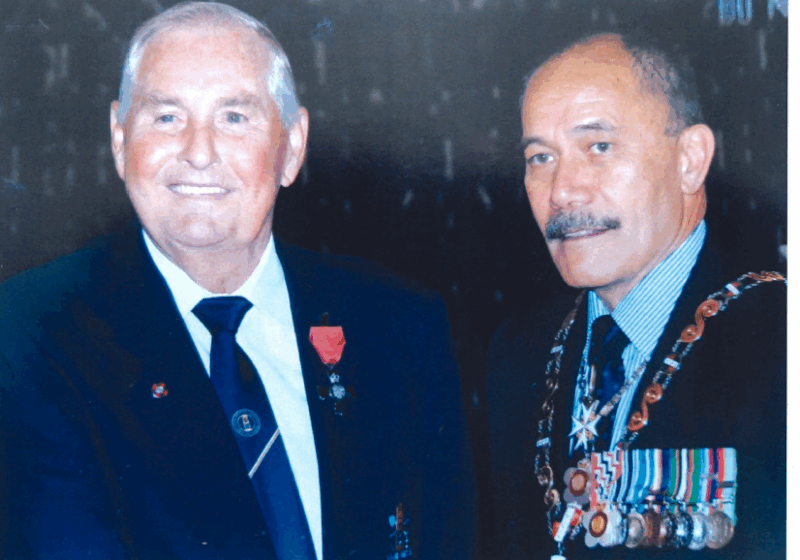
Image: Henry Walter Bell and Governor-General Sir Jerry Mateparae at Government House, Wellington, May 22, 2015
Now in his 90th year, Harry Bell is a legend within the mining industry, long recognised by his peers as a quietly dynamic individual of professional ability, and a loyal and true West Coaster.
Harry hails from a mining family, and his father came out here from Scotland and settled in Runanga to work in the mines.
When Harry left school, he worked as a rope road boy in the local mines and studied mining through The School of Mines, qualifying as a First Class Mine Manager. He progressed through the various stages to become an experienced miner, served with the Southland Mines Rescue as officer in charge of the Ohai district, and was a valued member of the West Coast Mines Rescue Brigade. He was later promoted to Inspector of Coal Mines and eventually appointed to the highest position, New Zealand Chief Inspector of Coal Mines. Even in retirement, he continued as a mining consultant and examiner for mining qualifications.
In Harry’s autobiography From the Bottom … to the Top he details his long and illustrious career which started when he was a teenager in the late 1940s.
His book speaks volumes on his successful career and provides a valuable insight into what being a coal miner was all about during a period when a lackadaisical government attitude to mining and softening industry regulations led to the Pike River disaster in 2010.
How did your coal mining career start?
West Coast jobs for boys were mainly sawmilling or coal mining. So, at the age of 15 I started at surface on the rope roads of the Liverpool No. 2 State Coal Mine earning 11 shillings and three pence a day.
When a ‘new boy’ started there, the longest serving boy would be sent underground. The rule then for working underground was that you had to be at least 18 years old but the boys who worked on the surface were sent underground ‘in turn’ and by the time I got down there I was only 16.
What were the highlight achievements in your career?
The young lads working underground would do various tasks as they demonstrated their ‘abilities’. As a young ‘face miner’ I was lucky to be assigned to a top miner on a job as we filled over 100 coal ships twice in one week. The miner’s union told us to stop doing this volume as management would use it against us when negotiating a pay increase. But I am still proud of that production achievement.
The State Coal Mines Department was getting short of mine managers, and I was asked to study at the Schools of Mines through correspondence school. I gained my First Class Coal Miners certificate this way. When I was the Inspector at Huntly I shut the West Mine down due to an underground fire and made management seal off the surface entrance. This mine blew up two days later with no loss of life.
The State Coal Mines Department was closing mines that were running at a loss. After closing four mines it was looking at Strongman. I was appointed manager and arranged to talk with the all the work force and the majority agreed with me to go along with my promise that I would introduce hydro-mining and scraper loaders to get production up. After a few months the tonnage did go up, the cost came down and the department looked elsewhere for closures.
You published a comprehensive book on your mining experience. Why were you so critical of the reforms that led up to Pike River?
When OHSH took over, it scrapped the mine Acts and Regs and did away with the experienced Inspectorate. I wrote to the Minister to no avail. The Pike mine was having a lot of gas problems and eventually blew up costing 29 lives. It all ended up as a ‘whitewash’ as far as I am concerned. The OHSH boss apologised to the families and nothing further happened and never will. I fell out with John Key, the PM at the time, over this.
Do you think there is a future for mining our coal?
I am pleased that I am at the age I am because the ‘greenies’ have too much say in this country.
While the current Government is encouraging mining investment – this is gold not coal. Meanwhile, the Aussies are producing more coal than ever, so it’s no wonder our good mining people have headed off to take advantage of this opportunity.
A deserving medal
When the then Minister of Energy Max Bradford offered to put Harry’s name forward for an award for his handling of the Huntly West Mine explosion, he declined. The subject cropped up again during the Pike River Mine Inquiry when he was one of their main witnesses during the hearing, and the Counsel representing the families put his name forward.
This time Harry thought about it after receiving a letter from Government House offering him the MNZM. “After due consideration, I decided to accept it. Having worked with the families’ lawyers, reading all the correspondence prior to the disaster and following it, I noted and brought to their attention multiple mistakes that the hierarchy at Pike River made that contributed to the tragedy.
“To this day, I cannot understand why mining-educated officials at the mine who were not happy with what they were seeing and putting up with did not speak up. Their silence allowed things to happen until matters snowballed from bad to worse, with tragic consequences.”