
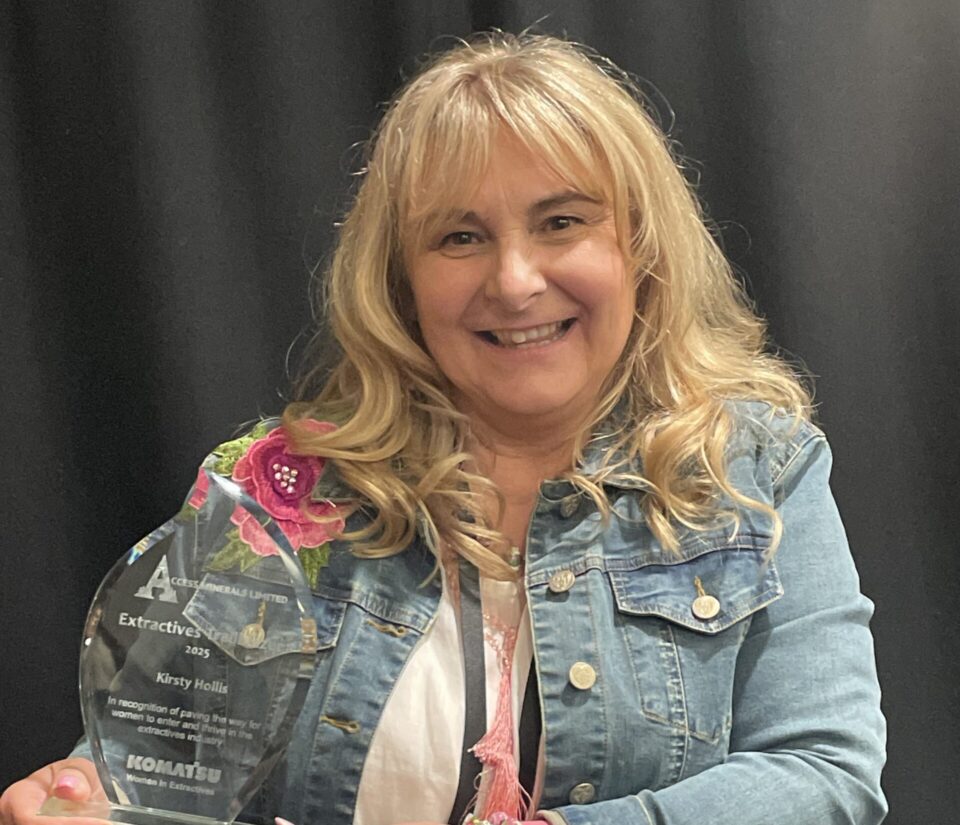
A winner of the Extractives Industry Trailblazer Award was Kirsty Hollis, a woman with many ‘firsts’ in the industry, all of which are simply the by-product of doing something she enjoys.
Those firsts range from the being the first female to graduate with an engineering degree in mineral processing, to becoming the first female process manager in the country. Kirsty has witnessed the industry evolving over the years – back in 1986 she had to get special permission to go underground in a coal mine as it was illegal for women to work underground in New Zealand up until 1987.
But Kirsty wasn’t out to ‘change the system’ or make waves, she is simply a strong-headed woman who chose to follow the path she wanted, regardless of whether it flouted societal norms.
Given her excellence in STEM subjects at school, Kirsty’s careers guidance counsellor thought engineering would be a good fit for the teenager. So she arranged for Kirsty to visit and chat with a number of different engineering firms throughout Waikato, from the hydropower station at Karapiro to the coal mine in Huntly.
“When I was at Huntly, I liked the idea of combining geology and engineering, and after that, I discovered I could do a minerals processing degree – which is essentially a cross between chemical engineering and geology.”
She completed her first year at the University of Waikato, before transferring to Auckland, where the mining school had just been transferred from Otago to the university’s Engineering School.
As with all engineering degrees, Kirsty was required to get practical experience during the summer holidays, so spent one break at State Coal in Huntly, another at Mt Isa in Queensland, and a third at NZ Steel’s ironsand mine.
“In my final year at university, I wrote a whole lot of letters to a variety of different mining operations asking for jobs – it’s what you did back then.
“The Olympic Dam Project in the outback of South Australia was being set up and they were taking on graduates, one of which was me. It was a very interesting time.
“The rules were that you could only live in the town if you worked at the mine. So, I was living in single person quarters. When the pub closed at night, I’d start getting knocks on my door. I never once opened it!”
Unsurprisingly, Kirsty soon got homesick and made the move back to New Zealand, returning to NZ Steel which had a vacancy for a young engineer as a mineral technologist.
“It was an excellent way to start my career as it was a very broad role. I did everything from supervising the drill rig to plant surveys to supervising the chemistry lab. The job covered all the technical aspects of mining operations.
“It did confirm for me that I like the chemistry and minerals processing side of things.”
In the late 1980s, as the gold price started to climb and New Zealand’s hard rock minerals industry started taking off, Kirsty got a role as a metallurgist with Macraes, which was just getting going.
“Macraes brought together lots of people from all over the world and plopped us down in the middle of nowhere. I made a lot of good friends. I guess the isolated locations means you become family with your colleagues.”
It was here that she got her first taste of the sexism inherent in the industry at the time.
“It was the first pour for Macraes and we had journalists on site to witness it. One of them got into the control room where I was and opened the conversation with that old cliché: ‘What’s a nice girl like you doing in a place like this?’ His next question was ‘Is your dad an engineer?’ I said, ‘No, and neither is my mother!’
“To his credit, he printed it.”
Kirsty attributes her attitude to her parents, who never discouraged her from taking this career path.
“My parents were very supportive, and education was important to them. Also, when I was young, my dad, who was an electronics technician and repaired cars for a hobby, allowed me to explore in his workshop. It made me unafraid of tinkering with things.”
After a few years with Macraes in Otago, the weather finally got to this Waikato girl. “I hated the cold!” So when a role came up at the Golden Cross Mine in Waihi, she jumped at the chance to move somewhere warmer and closer to family.
When Golden Cross Mine closed in 1997, there wasn’t a place at the nearby Martha Mine but there was a vacancy at the parent company’s Mt Leyshon gold mine in Australia. Kirsty was there for two years until another role came up in Waihi and she could transfer home.
Back in Waihi, she was promoted from senior metallurgist to process manager – which was not only a first for Waihi but for a New Zealand hard rock gold mine.
Her next career move was an exciting one. Transferring to the innovation team based at Newmont’s technical facility in its head office in Denver, Colorado, her new role involved visiting universities all over the world to see the new minerals processing tech they were developing.
“It was a very interesting and the most amazing job, and I absolutely loved it. But then the gold price tanked, and as the job was very much a ‘nice to have’ rather than a necessity, the whole team was made redundant.”
Kirsty’s next stop was in Southeast Asia, predominantly Laos, a location she describes as very different, but equally amazing. Here, for PanAust Mining, she worked as a process manager and was the company’s first female operations manager.
“Interestingly, Laos had a very strong women’s movement, even though it is a communist country. I think this was a by-product of part of the country’s drive to become a republic.
“This meant we had a lot of women on site – from truck drivers to lab workers – and the men were unfazed by females in these roles. I did employ the first female Laotian superintendent, a role previously held only by males or expat females.”
After six years in Southeast Asia, Kirsty returned to New Zealand, and in 2020 rejoined OceanaGold Macraes just in time for their 30th anniversary.
Her most recent move within the company saw her become Principal Metallurgist for OceanaGold last year.
“I’m part of the Brisbane Tech Services Team, providing tech support to all operations, notably Waihi and the Philippines.”
Kirsty says her recent award was “very exciting”, describing it as her first professional recognition.
“The quality of entrants was amazing and I didn’t think I stood a chance.
“Now I’m thinking, I know a few people who I must nominate for next year – to pass on the torch, as it were.”