
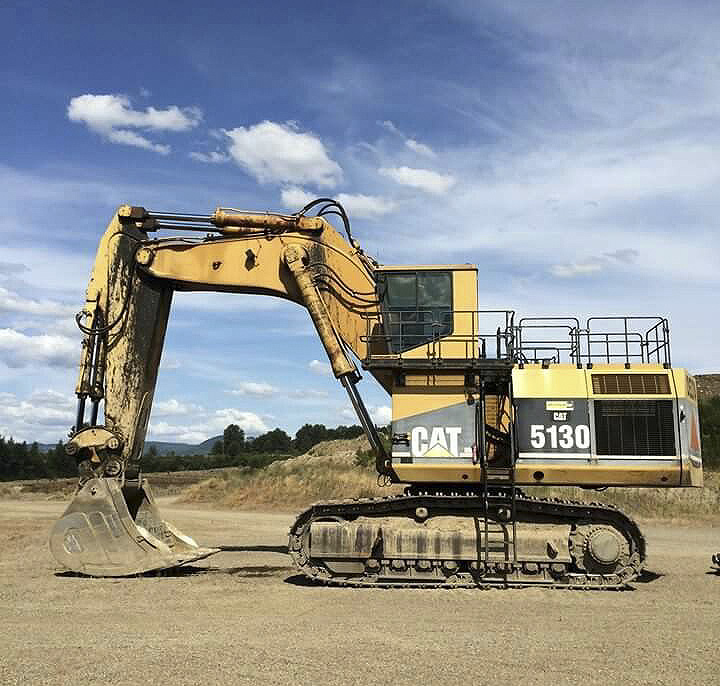
Image: A very early Caterpillar 5130 rigged as a backhoe and fitted with the long 5.2-metre stick. This particular machine appears to be equipped with the smaller general-purpose bucket.
In the late 1980s, Caterpillar realised it was missing out on the ever-increasing market for large hydraulic excavators – especially face shovels – and began a rapid development
programme to gain a share of this lucrative sector, explains Richard Campbell.
The resulting machine was the Caterpillar 5130 that Cat promotional literature of the day quoted as being “a robust piece of machinery designed to tackle a variety of heavy-duty tasks in construction, mining, and earthmoving”.
Available as both a conventional mass excavator and a dedicated face shovel, the first 5130s appeared in 1992 and were powered by a 755 flywheel horsepower Caterpillar 3508EUI V8 diesel engine.
When introduced, the 5130 (5ZL series) was the largest excavator that Caterpillar had offered to date, with the backhoe version weighing approximately 174 tons and wielding a bucket that could be anywhere from 13 to 18 cubic yards, depending on customer preference and the material being handled. It was twice the size of the previous largest Caterpillar excavator, the model 245 that the company had produced.
The 5130 face-shovel variant utilised the same powerplant but was slightly lighter at around 172 tons and could be equipped with a clamshell front shovel of between 11 to 14 cubic yards and was intended to work with
off-highway haulers of the 773 and 777 class (50–85 tons).
Standard track shoes for the backhoe version were 32 inch, while the front shovel was normally outfitted with 26-inch track shoes.
The 5130 had a massive eight-roller track frame manufactured from high-strength steel and featuring two carrier rollers per side. Despite the machines size, access for maintenance was relatively easy.
Both iterations of the 5130 were very impressive, especially the face shovel variant.
One of the 5130’s design concepts involved operator comfort and control.
The cab was spacious and equipped with ergonomic controls providing a comfortable workplace that allowed the operator to focus on the task at hand. Visibility was enhanced with large windows that reduced blind spots and improved safety during operation.
The 5130 backhoe version had a choice of two sticks, 3.8 metres (short) or 5.2 metres (long).
With the long stick fitted, the 5130 could dig to a depth of 9.7 metres.
Castings were used in all high stress areas of the machine to help eliminate structural problems and weld fractures.
Both excavator and face shovel versions of the 5130 were manufactured up until 1997 when the updated 5130B series was introduced.
The Caterpillar 5130B arrived in late 1997 and was fitted with a new engine – the Caterpillar 3508B EUI V8 diesel that was rated at 800 flywheel horsepower and featured a range of improvements over the former engine, not the least of which was exhaust emission controls.
With the 5130 series already having made a name for itself in reliability and efficiency, the new 5130B series was a popular choice among contractors and operators who needed performance without compromise.
Improved hydraulic system
One of the issues addressed by Caterpillar in the new 5130B was that of the hydraulic system. Some users of the former 5130 had complained that, while the machine had good power, the hydraulics were somewhat slower than other contemporary excavators leading to longer cycle times, so Caterpillar increased the output of the four main pumps slightly to address the problem.
This did not alter the travel speed of the machine which stayed the same as the previous 5130 at 3.3 km/h. The 5130B’s hydraulic tank held just over 1800 litres of hydraulic oil.
Fuel efficiency
Another issue that was improved on the 5130B was that of fuel consumption. Prior to the machine’s introduction, there had been some concern about fuel consumption and exhaust emissions as the world became increasingly concerned over such matters.
Caterpillar was well aware of this, and that fuel efficiency was a critical factor for any heavy equipment operation (especially mining).
The Caterpillar 5130B was designed with fuel-saving technology that reduced operational costs by optimizing fuel consumption, allowing the 5130B to achieve more work with less fuel, and lower emissions, important when your fuel tank holds 2600 litres!
End of the line
The Caterpillar 5130B remained in production until 2006 when the entire 5000 series of large Caterpillar excavators (5110, 5130 and 5230) was discontinued in favour of the new 6000 series, thus ending a chapter in Cat’s excavator history.
To the best of my knowledge, no 5130 or 5130B excavators were ever imported into New Zealand.
For the model collector
For those of you who collect models, you are in luck. To date, both versions of the 5130 (5130 and 5130B) have been released in model form in 1:50 scale by German diecast manufacturer NZG.
Both excavator and face shovel versions have been modelled, and although they are not the most well detailed of diecasts, they do form the basis for a model that can be super detailed if you wish.
Although all are (like the real thing) out of production, examples can be found on the internet and through specialist diecast retailers such as Buffalo Road Imports in the USA.
Happy hunting!