
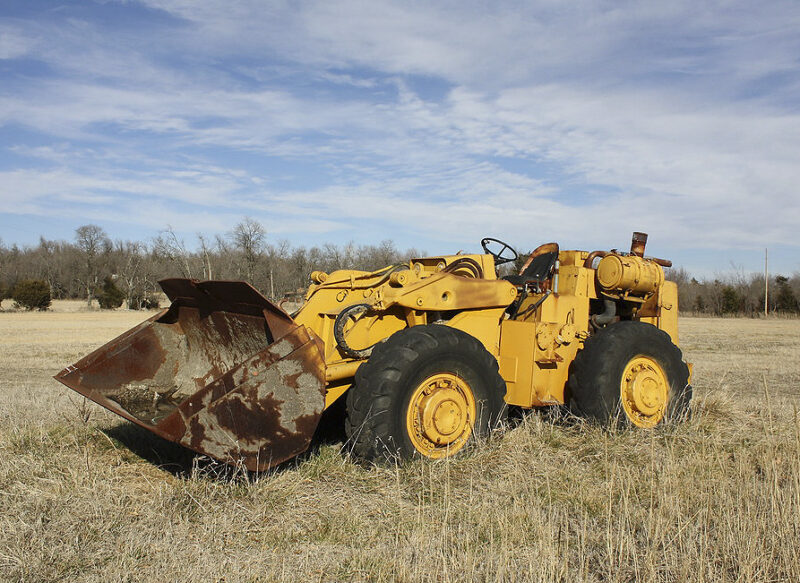

Image: First appearing in 1959, this is a Euclid model L-30, the granddaddy of the Euclid/Terex 72-51. This example has not seen any work for several years, and as can be seen, is out to pasture! Note that the yellow paint was not this machine’s original colour! PHOTO: INTERNET
Launched in 1966, the Euclid 72-51 wheel loader (later Terex) was developed from the highly successful Euclid L-30 and 72-40 models, introduced in 1959 and 1965 respectively, explains Richard Campbell.
Euclid had been one of the very earliest exponents of articulated steering in wheel loaders (or pivot-steer loaders as they were more commonly known in the USA), marketing its first production pivot-steer machine, the L-20, in 1958.
Weighing around 17 tons, the subject of this article, the model 72-51, was designed for general contracting, small quarry/mine sites, and logging skid site loadouts.
It was usually supplied ex-factory with a 3.5-cubic yard general purpose bucket.
As would be expected with a General Motors manufactured product, the 72-51 was powered with a Detroit Diesel engine, and in the case of the 72-51, this was the GM model 6-71N, six-cylinder, in-line diesel rated at 202 flywheel horsepower.
The 6-71N was a slightly more powerful development of the engine that had powered the original Euclid L-30 loader and represented an 11 horsepower increase over the previous model machine.
Allison (another GM-owned company) provided the powershift transmission – a model TT4420 that was a two-speed, two-stage type, giving torque converter drive and direct drive in each of its two speed ranges.
Unlike other articulated steer wheel loaders of the time, the Euclid 72-51 was set up so that the wheels did not actually track (follow each other) during a turn, as the articulation hinge point was somewhat further forward of the centre of the machine.
This did allow for more tighter turns than opposition wheel loaders, but the trade-off was that the operator had to be careful how they manoeuvred in tight spaces due to the unequal tracking.
Steering was via two identical double acting hydraulic cylinders with a backup safety steering accumulator.
A good safety feature – ahead of its time and fitted as standard – was the steering accumulator, which allowed for three lock-to-lock turns of the steering wheel in the event of an engine failure, or sufficient to get an operator out of trouble if need be.
Standard tyres were normally 23.5×25 wide base L3s, although other types could be fitted depending on the machines intended application.
The tyres could be ballasted with water for extra weight to increase the machine’s static tipping load; especially useful in a skid site load out application.
Brakes were air-operated s-cam shoe type acting on all wheels with a shoe type parking brake on the transmission output shaft.
The sharp end – buckets and attachment options
Euclid utilised an unconventional bucket lift arm set up and were one of only a handful of manufacturers who attached its bucket tilt cylinders directly to the back of the bucket, rather than through a linkage arrangement.
As mentioned previously, the standard bucket was a general-purpose type rated at 3.5 cubic yards. Optional buckets up to six cubic yards capacity for lighter weight materials were also available.
A Drott four-in-one bucket or log forks could be substituted for the standard bucket although these required the use of an extra third valve in the hydraulic system.
For the operator
Euclid wheel loaders in general were pretty basic machines with few real operator comforts. Cabs were not standard equipment until the early 1970s, and the operator’s environment was a little cramped.
Visibility was good to the front and sides but restricted to the left rear by the air cleaner and muffler.
The transmission shifter was mounted on the left side of the steering column with bucket operating controls emerging from a control console on the right-hand side next to the operator’s seat.
Basic instrumentation was provided on panels mounted on either side of the steering column.
Not known for their quietness in operation, many New Zealand- domiciled machines were fitted with larger, non-standard mufflers to save the operators ears, meet council noise bylaws, and pacify hostile locals who weren’t nearly as fond of the sound of the machine as the owner!
In summary
A contemporary of the Caterpillar 966C, Hough H90, Clark 125B and Allis-Chalmers 745, the Euclid 72-51 was a no-frills, brutish good- looks machine designed to do a job day in, day out with no fuss, and little downtime, a task which it performed admirably.
The 72-51 was manufactured in the United States, Great Britain, Brazil, and Luxemburg, and twelve Euclid 72-51s were imported here by the (then) dealer, Clyde Engineering and saw service throughout the country.
In 1970, due to several factors, Euclid changed the name of its earthmoving division to Terex and all subsequent model 72-51 wheel loaders delivered after July 1970 were branded as Terex items.
An improved version of the machine, the Terex 72-51B, was released in 1977, but this machine bore little resemblance to the original 72-51 apart from its name and falls outside the scope of this article.
For the model collector
Unfortunately for the collector, the only model which has been issued to date of the 72-51 is of its predecessor, the L-30, which was modelled by Mercury Models of Italy to 1:90 scale.
This is very small as you can imagine and is really only of curiosity value.
Hopefully, one of the boutique resin model builders will see fit to produce one in 1:50 scale before
too long.