
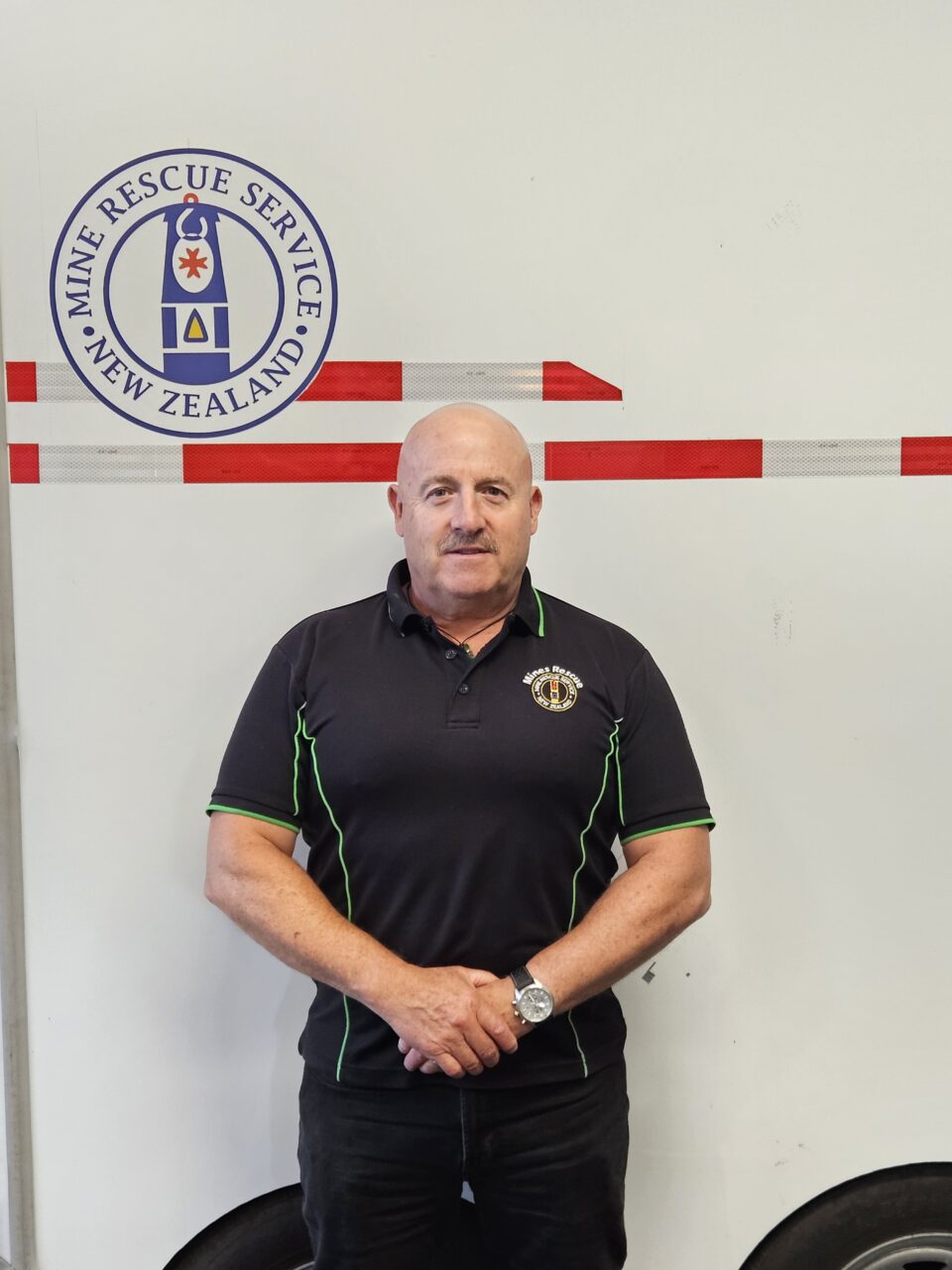

His baptism of fire was the Boatmans Mine disaster of 1985, just weeks after he joined the NZ Mines Rescue Service as a brigade member. Now, after 40 years in the job, Trevor Watts is heading into retirement. He talks with Hugh de Lacy.
Trevor Watts, who has been Station Manager, General Manager – and later Chief Executive Officer – of the NZ Mines Rescue Service, had been a brigade member for just over a month when, in September 1985, the New Imperial (Boatmans Number Four) coal mine near Reefton had an underground fire caused by spontaneous combustion, killing four miners.
It was a harsh introduction to mines rescue work for Watts.
“The Boatmans Mine tragedy was a baptism by fire so soon after my induction training,” he recalls, noting that it had been the biggest mining disaster since the Strongman Mine exploded near Runanga, killing 19 men in January 1967.
Living in the tight mining community of Reefton on the West Coast, Watts personally knew all four Boatmans victims – Ashley Bang, Lindsay Keily, Thomas Laird and Wayne Neville – and it rammed home to him the significance of the role he’d just taken on.
That experience, plus other emergencies, prepared him for the greatest challenge of his career, the 2010 Pike River disaster that took the lives of 29 miners.
Watts knew all of them too.
It was a matter of grinding regret to him that the Mines Rescue Service’s expanded focus into education and training had not been enough to prevent that disaster.
“Mines Rescue had started down the pathway to change its focus from responding to mine disasters to preventative education and training just before I joined, so I can’t take credit for that, but it’s grown exponentially over the last two decades.
“We’re now engaged with a lot of different industries outside the mining industry. For example, we do a lot of work with KiwiRail on tunnels, doing training and supplying them with specialist equipment and services.
“We’re very busy delivering training and specialist services, and we had people embedded in major projects like Auckland’s City Rail Link and its rail tunnel network, from 2020 to 2025, and Auckland’s big Central Interceptor sewerage tunnel project from 2019 to 2025.”
Mines Rescue had full-time staff in both those projects, as it did in the aftermath of the Kaikoura earthquake in 2016.
“We had staff embedded in a health and safety role in Kaikoura for three years in the post-quake period during the repairs to the road and rail tunnels.
“We were also called in for the recovery planning stage after the White Island eruption that killed 22 people in December 2019, because of the relationship we have with the police and other emergency agencies.
“This had developed from our working with senior policemen on the Pike River recovery, and continues to this day,” says Trevor.
The service, from its headquarters in Rapahoe on the West Coast, today has nine full-time staff working throughout the country, supported by about 50 brigade members nationwide.
“Staffing levels have fluctuated slightly – they were lower when I first joined up but have been up to more than a dozen at times.”
The service has evolved steadily since being established in 1930 in the wake of the 1926 Dobson Mine disaster that saw nine miners lose their lives.
The service had stations at Dobson and Granity on the Coast, Ohai in Southland, and Huntly in the Waikato but didn’t get its own legislation until the passage of the Mines Rescue Trust Act of 1992.
New legislation – the Mines Rescue Act – was passed in 2013 in the wake of the Pike River tragedy, extending the service’s coverage to underground metalliferous mines and tunnel construction.
“One of the prouder things I see looking back at Mines Rescue is that it’s moved on from being a reactive organisation, where we just waited for the phone to ring, into a pro-active organisation heavily involved in training and other services, where we’re doing what we can to assist our industry to prepare people, and bring knowledge and education into high-risk activities,” says Trevor.
He began his career in mining in 1981 and spent 16 years working in small, private, underground coal mines round Reefton, becoming a rescue service brigade member in 1985, along with fellow mining colleagues including John Mulligan, Mike Kennedy, Don Ladner, Jim Foster, Ross Moore, Andrew Holley and Richard Banks.
Trevor had also joined the local fire brigade as a volunteer in 1980, and served for 23 years, including the seven years he ran a school and charter bus service he’d bought off his father, Colin Watts.
It was in early 2004 that he landed a role with state-owned collier Solid Energy, helping with the training of staff and setting up breathing apparatus in the Spring Creek coal mine.
Later that year the station manager’s job came up at the Mines Rescue Service headquarters in Rapahoe, so he applied and landed it – meaning he will have been with the service for just on 41 years when he retires in June of this year.
His time as the head of the service was, of course, dominated by Pike River, still being investigated by the police 16 years on.
He declines to address the question of blame for the tragedy.
“A lot came out during the Commission of Inquiry that speaks for itself as to the shortcomings of what went on at Pike River.
“The Royal Commission has done a very good job, and I wouldn’t like to say anything more that could jeopardise the ongoing police investigation.”
In retirement he’ll still be doing “bits and pieces of work” but his main focus will be his family – three adult sons and six grandchildren, and especially his wife Belinda.
“Without whom I wouldn’t have been able to meet the challenges of the Mines Rescue Service job.”