
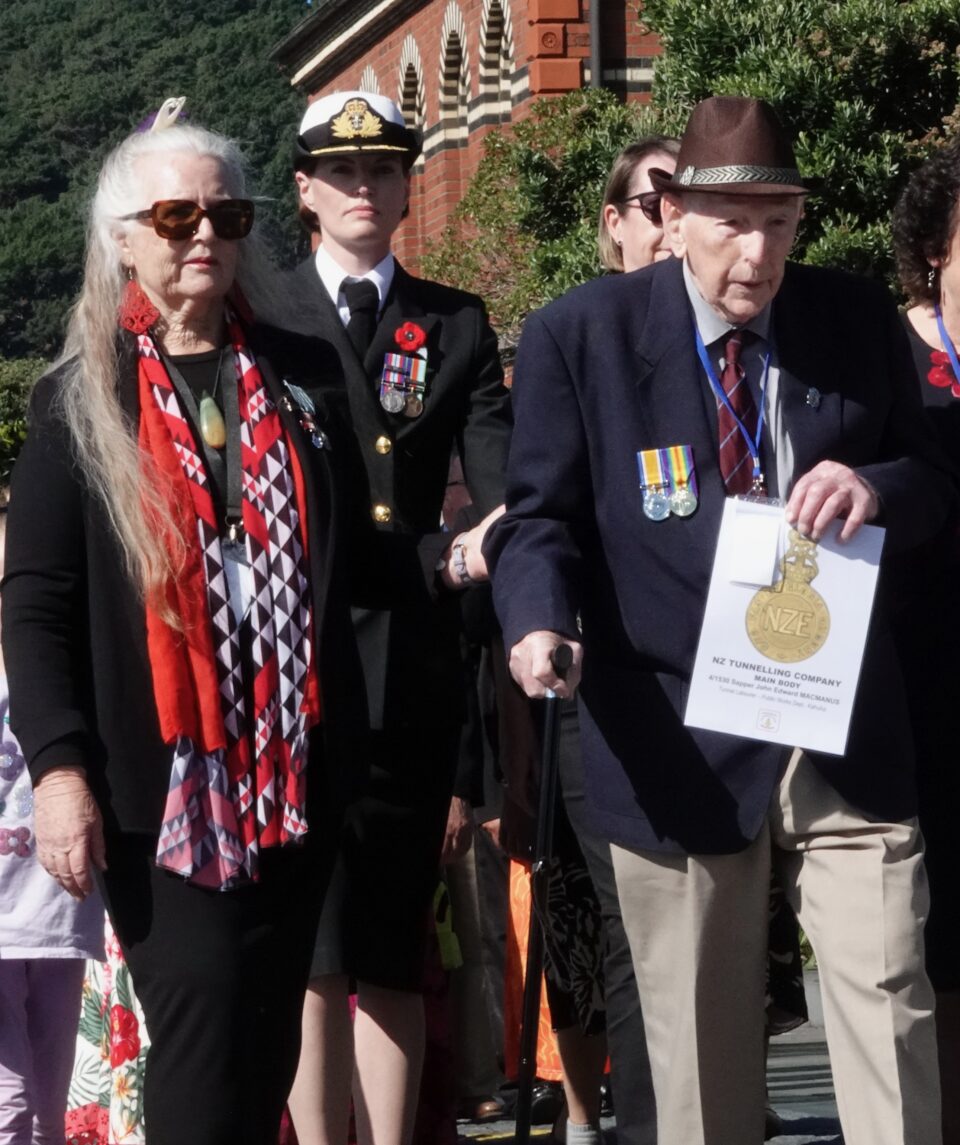

Image: Front row left to right: Event organiser Sue Baker Wilson leads 95 year-old descendant Ernie MacManus.
In April, descendants of men from WW1 NZ Tunnelling Company gathered at Pukeahu National War Memorial Park in Wellington marking the 110th anniversary since the Company arrived on the Western Front as part of the New Zealand Expeditionary Force. By Kit Wilson.
Around three hundred people attended the service.
The Tunnelling Company was largely made up of miners, quarrymen and public works employees from around the country. Miners from the West Coast and Waihi were part of the first New Zealand unit to arrive on the Western Front, not returning to this country as a Company until the day before Anzac Day in 1919.
They played a crucial role in the underground war around Arras in northern France, contributing to both offensive and defensive operations. Their work was vital in preparing for major offensives, including the Battle of Arras in April 1917.
Organiser Sue Baker Wilson says the group gathered in the capital to honour those men whose service and contribution has often not been understood, and to those they left behind.
“To stand on the sacred Anzac Square at Pukeahu National War Memorial Park in front of the National War Memorial was a very special moment as descendants paid their respects and shared their stories,” says Sue.
One of the reasons for holding the event in the capital was that many Wellington people did not understand the significance of the name of the Arras Tunnel or their city’s own special relationship to Arras.
“Our men left underground workings beneath the town of Arras. The Carrière Wellington museum includes a cavern named after our capital city.
“There, it is possible to retrace the steps of the New Zealand tunnellers from over a century ago. To help us remember and to strengthen the bond of friendship, on the other side of the world New Zealand named a road tunnel in Wellington after their town in France,” she says.
Roll of Honour names were read out, beginning with the first NZEF death on the Western Front who was a tunneller. Sue says the event was notable because it saw descendants, ex-military personnel, military vehicle collectors, Cook Islanders, New Zealand Chinese and French supporters, who all share the Tunnelling Company story, gather at Pukeahu.
She adds that it was also significant because as well as those who served, Tunnelling Company men who committed suicide after returning home were also remembered.
“For the first time that we are aware, a list of names of men who lost their lives to suicide after the war was read aloud on Pukeahu, a sacred space. Although their deaths may not show a direct link – for instance in a message left behind – it is likely that most, if not all, were casualties of war. Their descendants still live with this grief today, and it was appropriate that we acknowledged them and the loved ones they lost.
“We were also very pleased to have His Worship the Mayor of Wellington Andrew Little welcome the group to the capital and provide the opening remarks. We were also exceptionally fortunate to have Sir Jerry Mateparae as our keynote speaker.
“Sir Jerry has supported the Tunnellers since he was Governor-General. He has visited the Tunnellers Memorial in Waihi, and it was very special to have him join us.”
Other speakers include the French Ambassador Laurence Beau and Royal New Zealand Engineers Commandant, Colonel Paul Curry. Grey District Mayor Tania Gibson also attended the event, along with representatives from Bathurst Resources and OceanaGold.
“Miners and mining communities have a strong bond and an enduring relationship that spans geographical regions and stretches across centuries. On April 15 we remembered the links forged through shared experience. We say their names, so we do not forget.”