
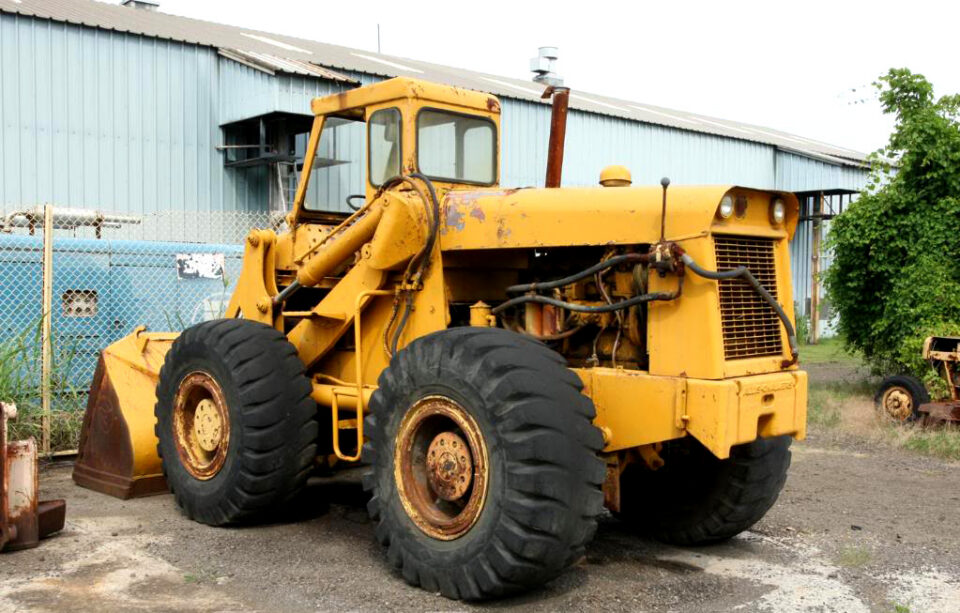

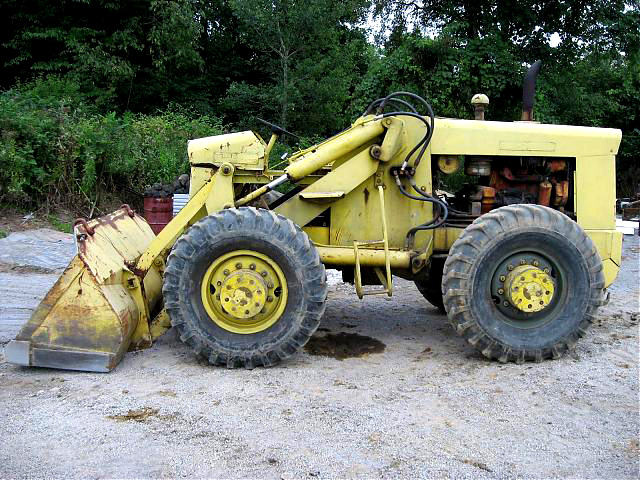
Image: A survivor, a Tractomotive model TL-20, still with its factory-fitted cab. The TL-20 carried a very useful five cubic yards and was quite at home in quarries and aggregate plants. This particular example is kept as a backup for when the main production machines are out of service for maintenance. Like the model TL-16, just under 2,000 TL-20s were manufactured between 1957 to 1963. PHOTO: AUTHOR’S COLLECTION
Tractomotive wheel loaders were well liked for their rugged simplicity and reliability and were sold widely throughout this country, with many of them surviving into the 1990s, writes Richard Campbell.
Enter any quarry or metal supplier in the 1940s–1960s era and there is a very good chance that you would come across an Allis-Chalmers or Tractomotive wheel loader.
An exceptionally versatile tool, the wheel loader has found a use in all phases of construction as well as quarry and aggregate production, material recycling, reclamation, rubbish transfer and heavy mining.
The wheel loader really came into its own in the 1950s with a great many manufacturers offering their version of this machine. Early loaders were based largely on agricultural two-wheel-drive tractors and operated back-to-front with the lifting arms or mast mounted on the tractor’s rear with the machine actually operating in reverse!
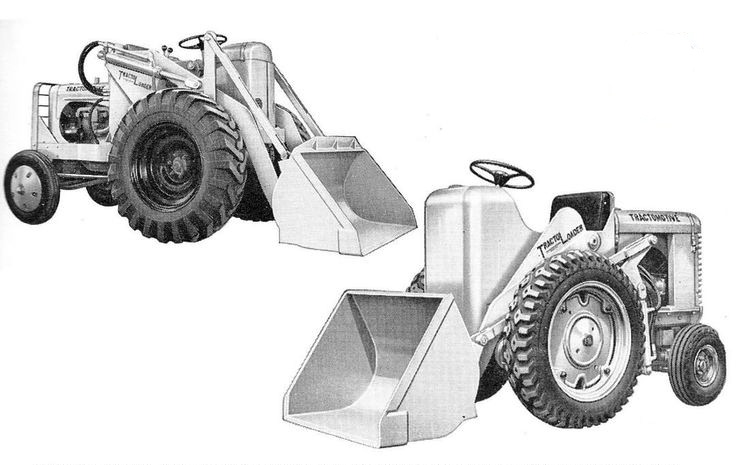
The first purpose-built machines to achieve real commercial success were designed by the Frank G Hough Company, who ultimately became a very important arm of the International Harvester Corp, Payline division.
Amongst the plethora of wheel loaders was Tractomotive, a wholly owned division of Allis-Chalmers. The machinery manufacturing company had had an association with Tractomotive for a considerable period of time before acquiring it outright in 1959.
Prior to its acquisition, Tractomotive had manufactured and supplied the pipelaying side booms, rippers and loader attachments for Allis’ track-type tractors.
More importantly, Tractomotive also utilized Allis-Chalmers wheel tractors as a base for their own wheel loaders. It turned out to be a very convenient marriage.
Front end loader development
As was the case with most of their competitors, Tractomotive used rigid frame two-wheel-drive tractors as the base unit for their wheel loaders.
These machines, the models TL-B and TL-W, were conversions of existing Allis-Chalmers agricultural tractors and not strictly dedicated wheel loaders.
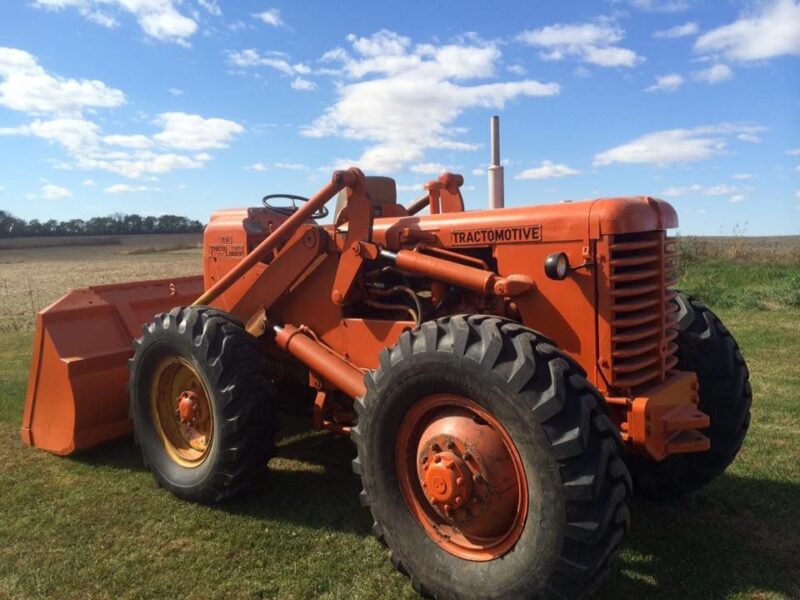
Tractomotive’s trade name for their wheel loaders was ‘Tracto-Shovel’ and ‘Tracto-Loader’ and they were all sold and serviced through the Allis-Chalmers dealer network.
Their first ‘from the ground up’ wheel loader was the model TL-10 (which replaced the TL-W), a one-cubic-yard, two-wheel-drive machine that sold particularly well and firmly established Tractomotive as a producer of good, reliable equipment.
Available with either a gasoline or diesel engine, the loader was also the first Tractomotive machine to feature a torque converter drive and was in continuous production from 1951 through 1964.
Tractomotive’s next offering, the model TL-12, was a runaway success worldwide and sold literally in the thousands.
It was the first Tractomotive machine to feature all-wheel drive and a torque converter drive power shuttle transmission, weighing in at around six tons and carrying a 1.25-cubic-yard bucket.
The TL-12 was produced from 1954 right up until 1965, when it was replaced by the articulated steer (now Allis-Chalmers) model TL545.
It was available with either a 63 horsepower, four-cylinder gasoline engine, or a 77 horsepower, six-cylinder diesel, both manufactured by Allis-Chalmers.
Something a little larger
Following on the success of the TL-12, came the model TL-14 (three cubic yards), TL-16 (four cubic yards), TL-20 (five cubic yards), TL-30 (six cubic yards) and the giant TL-40 which was rated at a massive (for the time), seven-cubic- yards bucket capacity.
The TL-40 also spawned Allis-Chalmers’ attempt at a wheel dozer named the D-40, which was produced in limited quantities.
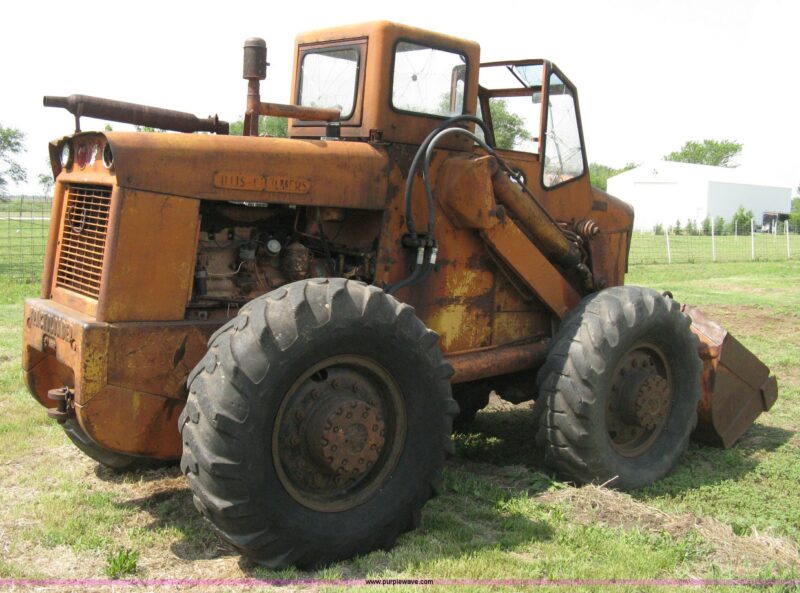
These were the last rigid frame, rear-wheel steer loaders made by Tractomotive before Allis-Chalmers completely absorbed the company and introduced their own indigenously designed articulated steer machines, the 345, 545, 645, 745 and 945.
However, the Tractomotive name continued on for a while in the new Allis-Chalmers series of wheel loaders which were referred to as TL545, TL645 etc., a direct recognition and acknowledgement of the new machine’s distinguished heritage.
The Tractomotive wheel loader – a basic layout
All of the Tractomotive’s wheel loaders featured a rigid (non-articulating) main frame with rear-wheel, power-boosted steering.
The operator sat well up front, with a good view of the bucket and work area and with the engine behind him at the rear, forming part of the machine’s counterweight.
Early machines featured a foot clutch for the manual transmission, but Tractomotive’s engineers were pioneers in fitting power shuttle transmissions to these machines, reducing the amount of shifting required to perform a work cycle.
As time progressed, the shuttle transmissions were replaced by full powershift types, usually supplied by Allison or Twin-Disc.
Tractomotive always offered the prospective buyer a choice of powerplants; either gasoline or diesel of various outputs. As gasoline became progressively more expensive, this option was dropped in favour of diesel only.
Work tools were available in a wide range of types; from general purpose and rock buckets through to dozer blades, snow blowers, side booms and forks, making this wheel loader the original all terrain forklift!
Drott also made their four-in-one bucket available to Tractomotive where a little more versatility was required. This option necessitated the fitting of an extra valve to the hydraulic system for operation.
One of the drawbacks of a rigid frame loader is the area required to manoeuvre; however, the major concern was one of safety.
With loader lift arms tucked in close into the side of the machine’s chassis, these were capable of amputating a careless operator’s arms when they lowered, making the machines quite dangerous to drive unless you remained very vigilant.
The narrow chassis also meant that the operator’s compartment was cramped and a long shift in a machine of this type could be quite fatiguing. Cabs, when fitted, were noisy and poorly insulated, and very difficult to get out of in a hurry, should the machine overturn.
Nonetheless, Tractomotive’s contribution to the evolution of the wheel loader was a very important one and should not go unrecognized.
Tractomotive wheel loaders were sold widely throughout New Zealand, by CablePrice in the North Island and Andrews and Bevan in the South Island.
Their rugged simplicity and reliability were well liked, and many of them survived into the 1990s as backup machines for newer wheel loaders, whose increasing complexity made quick repairs an unlikely event.
For the model collector
Regrettably, no commercially produced models exist of any Tractomotive or Allis-Chalmers wheel loaders. Considering their place in history, and contribution to the earthmoving industry, this is a great pity.
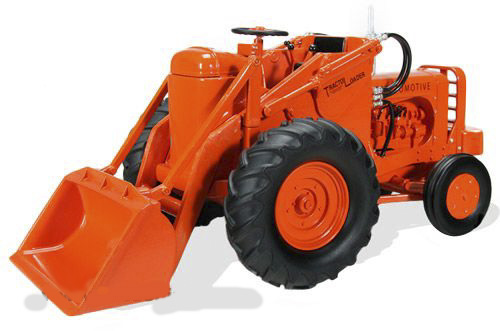
There is a custom-produced model to 1:16 scale of the Tractomotive model TL-W. This is a mixed-media model (resin/brass/plastic) but is very hard to find, and as you can probably guess, expensive.