
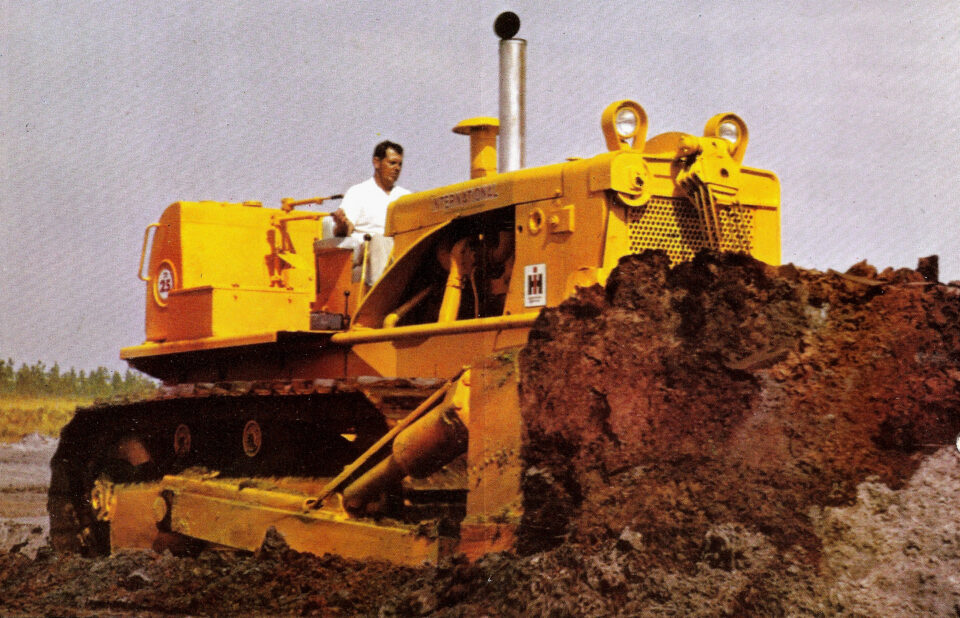

Image: Near-new International TD-25B on test at International’s proving grounds in 1963. The machine is equipped with a cable-operated S-blade with hydraulic tilt cylinder. The cable control (out of sight in this picture) is mounted on the rear of the tractor with the cable routed along the right-hand side, a common practice in the ’50s and ’60s.
International Harvester had a long history in the track-type tractor market and unlike a lot of its contemporaries, designed and built its own machines rather than acquiring an existing manufacturer. Following on from their very successful model TD-24 track-type tractor (of which over 11,000 were manufactured), the company introduced its replacement, the TD-25, in 1959, writes Richard Campbell.
Rather than being a scaled-up version of the previous TD-24, the TD-25 was a completely new machine.
The earlier TD-24 had not been without its faults, which, over the period of its production life, International had tried very hard to iron out.
A lot of these problems had been in the form of transmission failures and cylinder head cracking and were caused in part by hastily putting the machine into service without adequate testing in order to compete with the new Allis-Chalmers’ HD-19.
While many improvements were made, International never completely cured the cylinder head cracking problem despite several modifications to the design.
Determined not to make the same mistake again, International designed an all-new 230 flywheel horsepower, six-cylinder turbocharged diesel engine, the DT-817, for its new tractor, which was called the TD-25 and tipped the scales at around 20.5 tons bare.
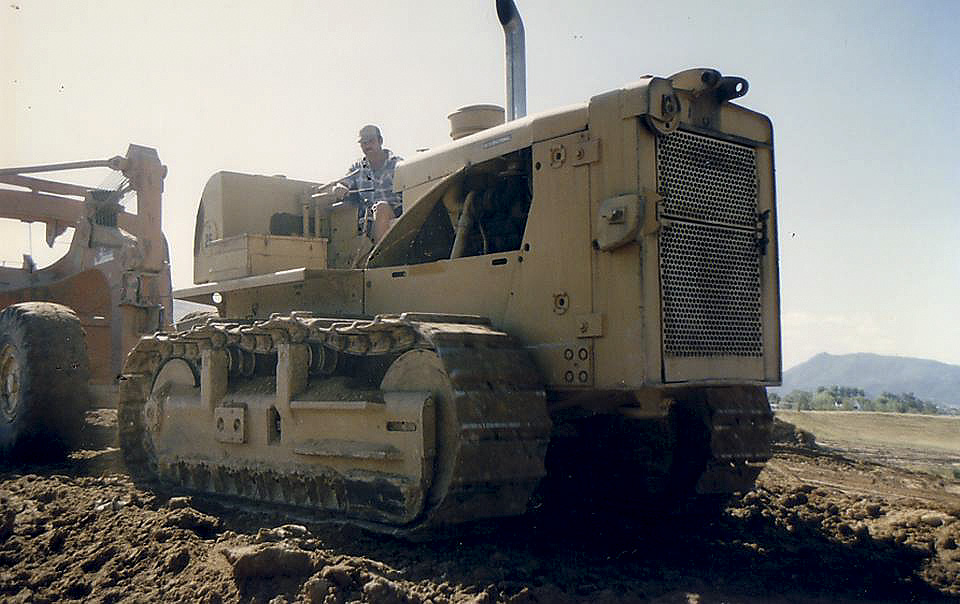
Size-wise, the new TD-25 competed head-on with Caterpillar’s D8H and Allis-Chalmers’ new HD21 – both formidable tractors in their own right.
Initial deliveries of the new TD-25 commenced in 1959, and it quickly became apparent that International had made a really good tractor.
Both power shift and direct drive transmission versions of the machine were available.
Acutely aware of the problems they had faced with the previous TD-24, International kept a keen eye on things and on what improvements could be incorporated. As a result, an improved model TD-25B was released in 1962, featuring more horsepower (up from 230 to 240 hp) from the model DT-817B diesel engine, considerably more weight (26 tons), and some cosmetic refinements to the shape of the sheet metal on the bonnet and radiator guard.
The TD-25B also proved to be a popular tractor and sold in good quantities.
Another improved version – the TD-25C
The TD-25B had had a good production run from 1962 to 1972, at which point International, which had been keeping a close eye on the competition, introduced its successor, the TD-25C.
Improvements to the DT-817B diesel engine resulted in the new model DT-817C engine which now produced 285 flywheel horsepower.
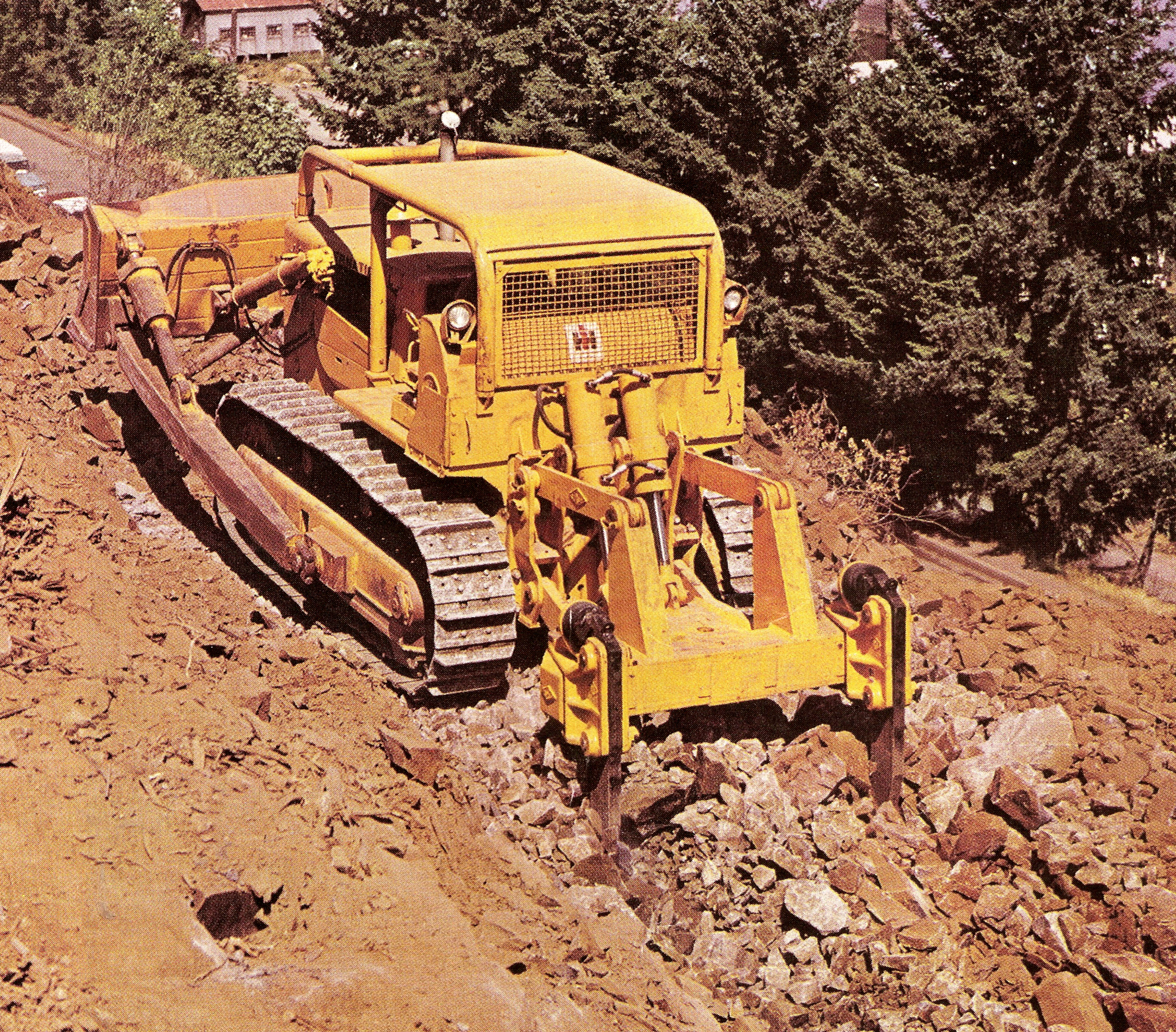
Many other improvements were made to the machine as well as another revision to the hood assembly and radiator surround, which was now much more rounded in appearance than previous versions of the machine.
Weight also grew, now up to 30 tons.
Unusually, the TD-25C was introduced before production of the former TD-25B had finished, with the first TD-25Cs coming off the line in 1968.
Production of the TD-25C, which was the most popular of all the TD-25 variants, ran through to 1979.
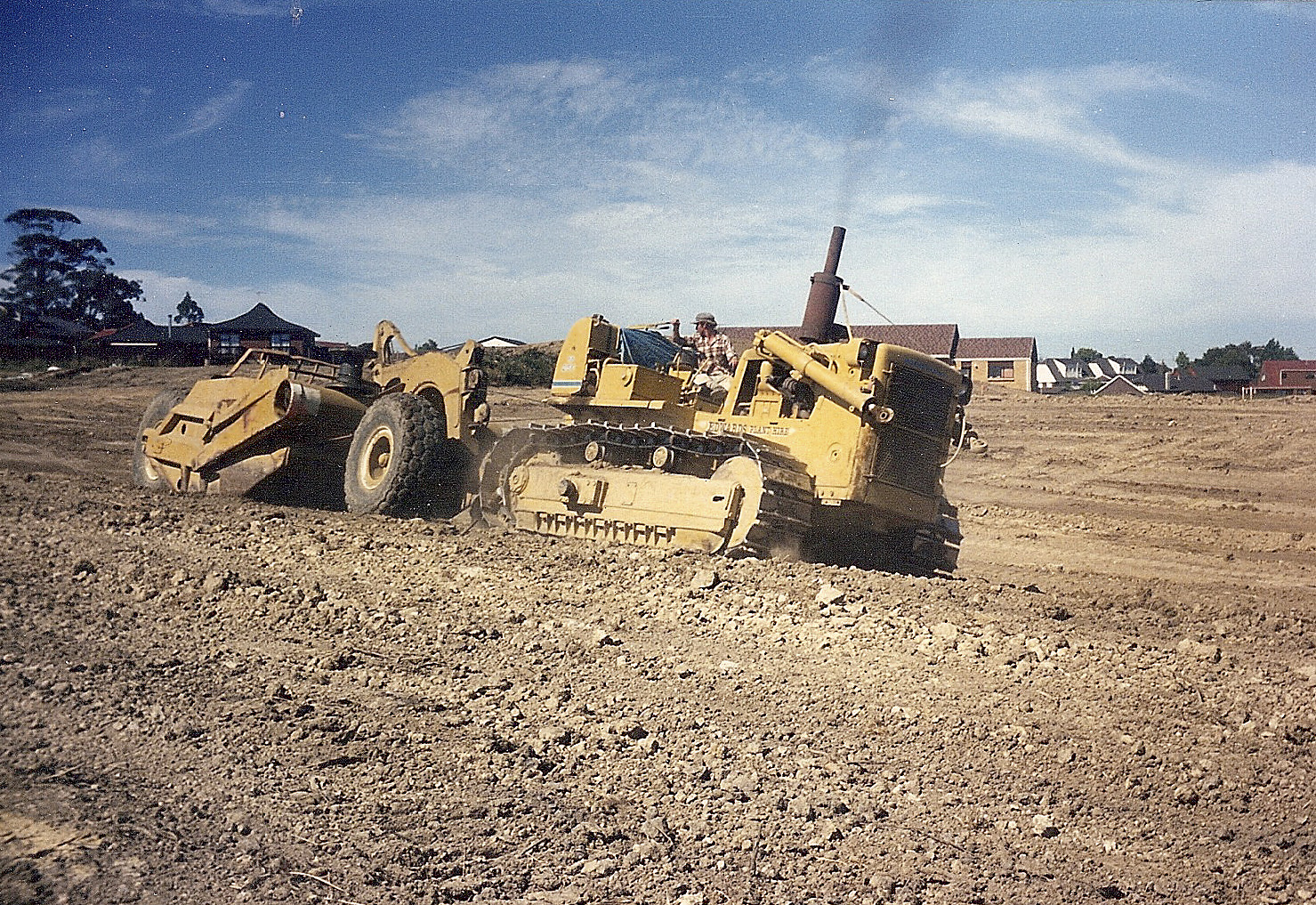
Unfortunate developments
In an uncertain economic climate, the last version of the TD-25 that International Harvester had anything directly to do with was the model TD-25E, introduced in 1979.
The TD-25E (there was no TD-25D) added an intercooler to the DT-817C diesel engine, resulting in a minor horsepower increase up to 310 horsepower.
Weight remained at around 30 tons.
In a shock move, International Harvester’s earthmoving division was sold to Dresser Industries in 1982, and Dresser continued to build and market the TD-25E up until 1984.
Dresser introduced a 320-flywheel horsepower TD25G version in late 1984, but by now the machine was far removed from the original TD25.
More doom and gloom
Following significant financial losses during 1987, Komatsu of Japan entered the picture and picked up a 50 percent share in Dresser Industries.
Komatsu, a major manufacturer of heavy equipment in its own right, had no need for another track-type tractor line as it already had a very successful one of its own, so the Dresser track-type tractors were sold to HSW Industries of Poland in 2005, where the TD25 continues to be produced, only now known as the Dressta TD25M.
Points of interest
What many folks may not know is that International Harvester offered the TD-25 up to and including the TD-25C variant with a manual transmission option, featuring eight speeds and an oil clutch.
The powershift transmission version had two speeds forward and reverse with a high and low range, effectively giving the machine four forward and reverse speeds.
The standard track frame contained seven bottom and two carrier rollers per side and was pivoted at the rear through double reduction final drives. A pinned equalizer bar allowed track frame oscillation of 17 inches.
Standard track shoes were 22-inch single grouser although, of course, other options were available depending on customer requirements.
A very wide and clean deck area was provided for the operator who sat in a deeply cushioned seat. From the seat, visibility was very good all round, including to the rear, over the contoured fuel tank.
Outfitting your TD-25
A wide variety of attachments could be fitted to the TD-25 including a 13 foot straight blade, 15 foot angle blade or an 18 foot full U-blade.
These could be cable or hydraulically controlled (hydraulic only after the ‘C’ model) and were manufactured by International itself rather than by Allied or Bucyrus-Erie who had built the attachments for the former International TD24.
Radial arc or parallelogram rippers could also be fitted and included those manufactured by International, Ateco and CRC-Kelly.
International also offered a double drum cable control but some examples have been seen with a Caterpillar No.29 double drum unit which seemed to work just as well!
In logging applications, some TD25s were fitted with Hyster winches but by far the favoured type was the Carco F50.
For the model collector
Several examples of the International TD-25 have been offered in model form.
Undoubtedly the best of these were made by First Gear and were available in 1:87, 1:50 and 1:25 scales.
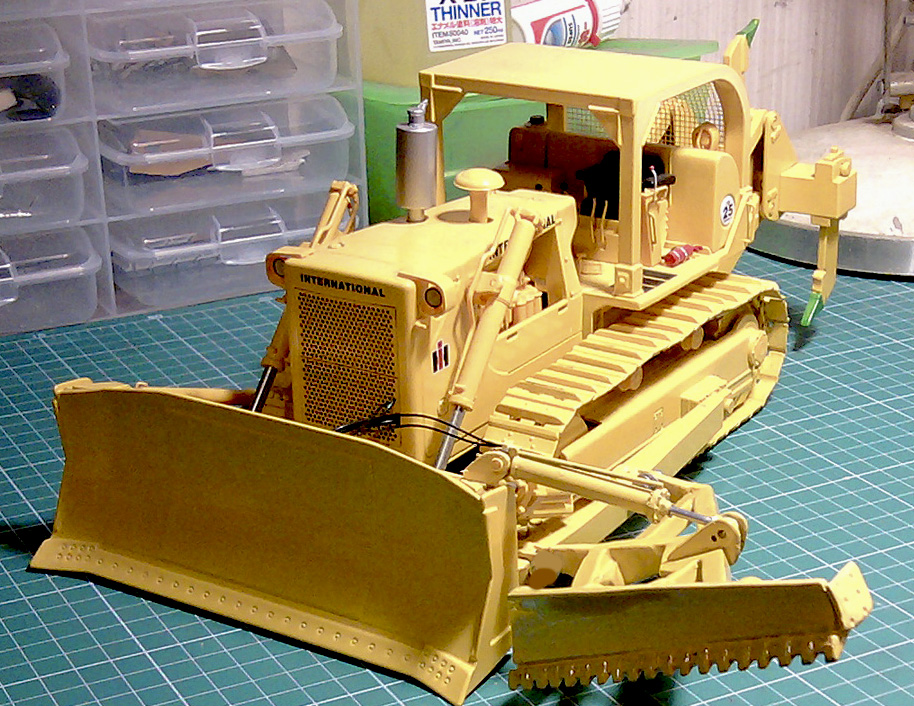
All of First Gear’s models represent late production TD-25Cs with the 1:25 scale version being of museum quality and well worth adding to your collection.
The 1:25 scale TD25C has been issued at least six times by First Gear in different configurations but is now out of production and increasingly hard to find.
There is also an Ertl/Eska model of a TD-25A model, manufactured in the mid-1960s to approximately 1:25 scale. While a fair reproduction for the time period, examples are quite scarce and regarded as collectors’ items.